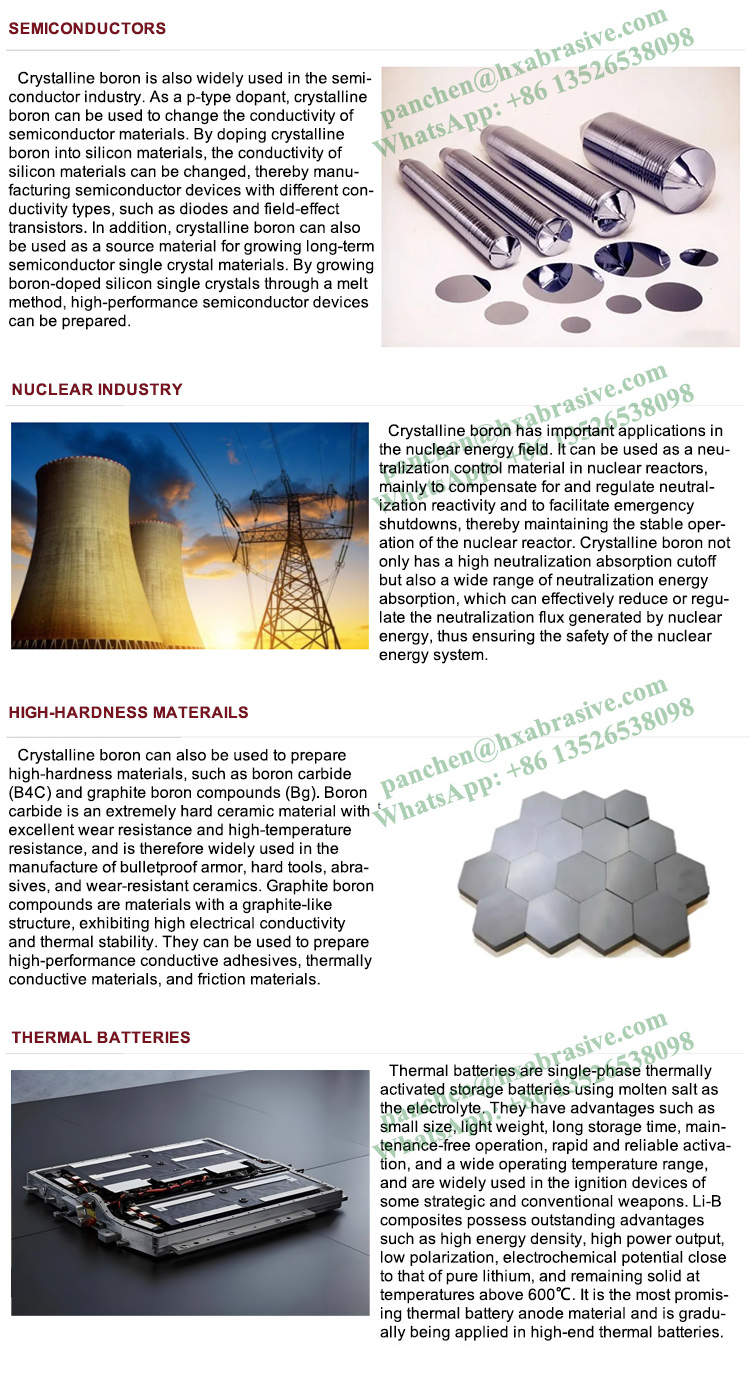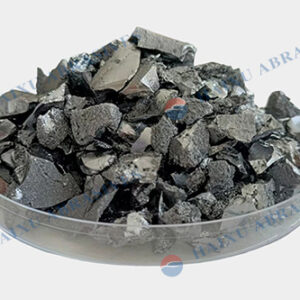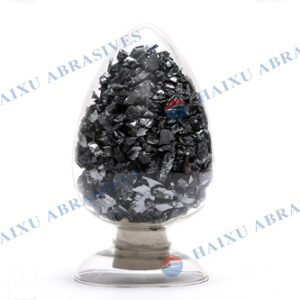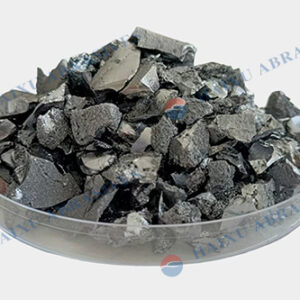
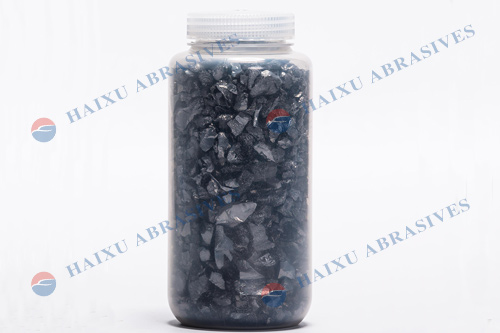
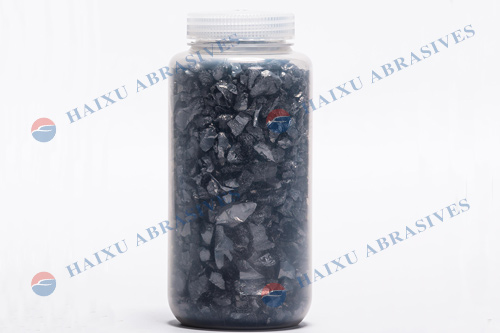
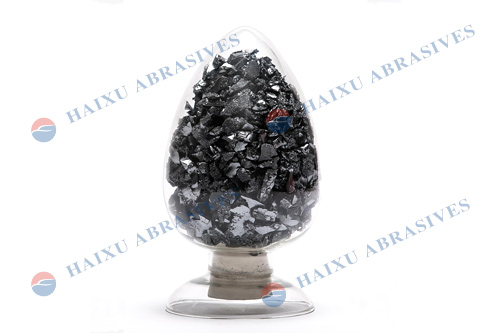
ผงโบรอนผลึก 3N 4N ขนาด 3-5 มม. และ 5-10 มม. จากประเทศจีน
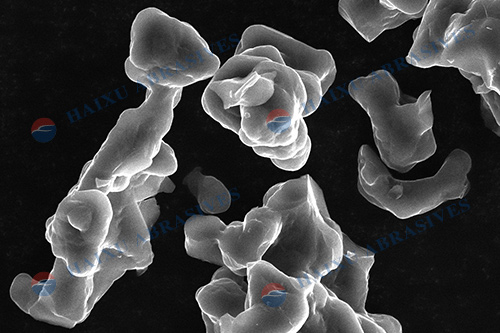
3N 4N โบรอนผลึกแบบเม็ด ขนาด 3-5 มม. และ 5-10 มม. จากประเทศจีน เป็นสารเติมแต่งอนินทรีย์เชิงฟังก์ชันที่สำคัญในภาคอุตสาหกรรม โบรอนผลึกเป็นธาตุโบรอนในเฟส β ที่มีโครงสร้างผลึกแบบทรงยี่สิบหน้าแบบรอมบิก มีคุณสมบัติเฉื่อยทางเคมีสูง ความแข็งเชิงกลสูง และจุดหลอมเหลวสูง โบรอนผลึกมีทั้งในรูปเม็ดและผง สีเทาอมดำ มีการใช้งานอย่างแพร่หลายในอุตสาหกรรมต่างๆ เช่น เซมิคอนดักเตอร์ ออปติก แบตเตอรี่ความร้อน และวัสดุผงเซรามิก
ผงโบรอนผลึกจากเรามีขนาดอนุภาคปกติอยู่ที่ 15-60 ไมโครเมตร ขนาดเกรนทั่วไปของอนุภาคโบรอนผลึกอยู่ที่ 1-10 มิลลิเมตร (สามารถปรับแต่งขนาดเกรนพิเศษได้ตามความต้องการของลูกค้า) โดยทั่วไปแบ่งออกเป็น 5 ระดับความบริสุทธิ์ ได้แก่ 2N, 3N, 4N, 5N และ 6N
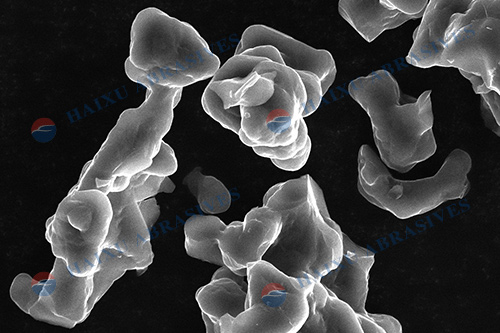
ดัชนีผลิตภัณฑ์ของเม็ดโบรอนผลึก 3N 4N ขนาด 3-5 มม. และ 5-10 มม. จากประเทศจีน:
| สูตรโมเลกุล: | บี |
| แคส | 7440-42-8 |
| ความหนาแน่น | 2.3 กรัม/ซม³ |
| เฟส | เฟส β-B |
| จุดหลอมเหลว | 2300°C |
| จุดเดือด | 2550°C |
| ความแข็งโมห์ส | >9 |
| มวลอะตอมสัมพัทธ์ | 10.81 |
| ไอโซโทปเสถียร | 10B、11B |
| สี | สีเทาเข้ม, สีดำ |
องค์ประกอบทางเคมี:
| เคมี | โบรอนผลึก 2N | โบรอนผลึก 3N | โบรอนผลึก 4N | โบรอนผลึก 5N | โบรอนผลึก 6N |
| บี | ≥99% | ≥99.9% | ≥99.99% | ≥99.999% | ≥99.9999% |
| เฟ | ≤500 ppm | ≤200 ppm | ≤90 ppm | ≤8 ppm | ≤0.5 ppm |
| ที่ | ≤2.5 ppm | ≤0.08 ppm | ≤0.06 ppm | ≤0.02 ppm | ≤0.02 ppm |
| ที่ | ≤1 ppm | ≤0.8 ppm | ≤0.3 ppm | ≤0.03 ppm | ≤0.03 ppm |
| กับ | ≤12 ppm | ≤10 ppm | ≤0.1 ppm | ≤0.03 ppm | ≤0.03 ppm |
| ส.น. | ≤30 ppm | ≤9 ppm | ≤0.1 ppm | ≤0.1 ppm | ≤0.08 ppm |
| มน. | ≤300 ppm | ≤3 ppm | ≤1.1 ppm | ≤0.1 ppm | ≤0.07 ppm |
| ตะกั่ว | ≤0.08 ppm | ≤0.3 ppm | ≤1.1 ppm | ≤0.08 ppm | ≤0.02 ppm |
| ที่ | / | ≤18 ppm | ≤0.2 ppm | ≤0.1 ppm | ≤0.01 ppm |
| เช่น | / | / | / | ≤0.08 ppm | ≤0.01 ppm |
| ใน | / | / | / | ≤0.05 ppm | ≤0.02 ppm |
| เก | / | / | / | ≤0.05 ppm | ≤0.04 ppm |
ขนาดและบรรจุภัณฑ์โดยทั่วไป:
| ปริมาณโบรอน | ขนาดทั่วไป | บรรจุุภัณฑ์ |
| 99 | 1-5 ไมโครเมตร, 10-30 ไมโครเมตร, 50-100 ไมโครเมตร | บรรจุ 1 กก./5 กก. ในถุงฟอยล์อลูมิเนียมสุญญากาศ (เฉพาะผงนาโนเท่านั้นที่ปิดผนึก ไม่มีการดูดอากาศ) |
| 99.9 | -200 เมช, 0-10 ไมโครเมตร, 1-10 มิลลิเมตร | ชนิดผง: บรรจุ 1 กก./5 กก. ในถุงฟอยล์อลูมิเนียมสุญญากาศ
ชนิดเม็ด: บรรจุ 50 กรัม/500 กรัม/1000 กรัม ในขวด PP บรรจุด้วยก๊าซเฉื่อยเพื่อป้องกันการรั่วไหล |
| 99.99 | -200Mesh, 1-10mm | บรรจุในขวด PP ขนาด 50 กรัม/100 กรัม พร้อมซีลกันก๊าซเฉื่อย |
| 99.999 | ||
| 99.9999 |
แอปพลิเคชัน:
1. การประยุกต์ใช้โบรอนผลึกในอุตสาหกรรมนิวเคลียร์:
Crystalline boron plays a crucial role in the nuclear energy field. It can be used as a neutralization control material in nuclear reactors. Boron can compensate for and regulate neutralization reactivity and to facilitate emergency shutdowns. Thus maintains stable reactor operation. Crystalline boron not only has a high neutralization absorption cutoff but also a wide range of neutralization energy absorption, effectively reducing or regulating the neutralization flux generated by nuclear energy. Thereby it ensures the safety of the nuclear energy system.
2. Applications of Crystalline Boron in Semiconductor Manufacturing:
Crystalline boron is also widely used in the semiconductor industry. As a p-type dopant, crystalline boron can be used to modify the conductivity of semiconductor materials. By doping crystalline boron into silicon Ingot, the conductivity properties of silicon can be altered. Then manufacture semiconductor devices with different conductivity types, such as diodes and field-effect transistors. In addition, crystalline boron can also be used as a raw material for growing long-lasting semiconductor single-crystal materials. Boron-doped silicon single crystals can be grown using a melt-blown method for fabricating high-performance semiconductor devices.
99.9% purity crystalline boron powder is used in the production of solar silicon wafers as a substrate dopant for P-type silicon wafers and as a boron emitter diffuser for N-type silicon wafers. High-purity boron powders of 5N and 6N can be used as dopants for P-type semiconductors to alter their conductivity and are used in the production of high-purity silicon wafers.
3. Application of crystalline boron in semiconductor sputtering targets:
3N and 4N crystalline boron particles can be added to functional alloy products to form targets for semiconductor sputtering coating.
4. Applications of Crystalline Boron in Optics:
Crystalline boron also has extensive applications in optics. Due to its excellent nonlinear optical properties, crystalline boron can achieve functions such as light modulation, frequency sweeping, and frequency doubling. Therefore, crystalline boron is widely used in optical devices, including optical modulators, optical frequency combs, and lasers. Furthermore, crystalline boron can also be used as a gain medium in infrared lasers, exhibiting a large emission cutoff and a wide excitation spectrum range.
5. Crystalline Boron in High-Hardness Ceramic Materials:
Crystalline boron can also be used to prepare high-hardness materials, such as boron carbide (B4C) and graphite boron compounds (Bg). Boron carbide is an extremely hard ceramic material with excellent wear resistance and high-temperature resistance, and is therefore widely used in the manufacture of bulletproof armor, hard tools, abrasives, and wear-resistant ceramics. Graphite boron compounds are materials with a graphite-like structure, exhibiting high electrical conductivity and thermal stability, and can be used to prepare high-performance conductive binders, thermally conductive materials, and friction materials.
6. Applications of Crystalline Boron in Thermal Batteries:
Thermal batteries are single-phase thermally activated storage batteries using molten salt as the electrolyte. They have advantages such as small size, light weight, long storage time, maintenance-free operation, rapid and reliable activation, and a wide operating temperature range, and are widely used in the ignition devices of some strategic and conventional weapons. The anode material of a thermal battery plays a decisive role in its capacity, volume, and power output. Thermal battery anode materials have evolved from the initial magnesium-based and calcium-based materials to the current lithium-based materials. For example, Li-B composites possess outstanding advantages such as high energy density, high power output, low polarization, electrochemical potential close to that of pure lithium, and remaining solid at temperatures above 600℃. It is the most promising thermal battery anode material and is gradually being applied in high-end thermal batteries.
7. Applications of Crystalline Boron in the Military Industry:
Crystalline boron can be used to manufacture high-purity boron ceramic ballistic materials, high-purity boron delay agents, high-purity boron welding fluxes, high-purity boron explosives, and high-purity boron fuel-rich and oxygen-depleted rocket propellants.
8. Crystalline boron in alloy manufacturing:
High-purity boron copper alloy, high-purity boron titanium alloy, high-purity boron polycrystalline steel, high-purity boron superhard wear-resistant tools, high-purity boron corrosion-resistant steel plates, high-purity boron nickel alloy, high-purity boron chromium alloy, lithium boron alloy (a novel battery material), boron-magnesium superconducting alloy.
9. Applications of crystalline boron in aerospace:
High-purity crystalline boron powder can be used as a nano-coating powder material. Through sputtering technology, the powder material is coated onto the surface of a substrate, making components wear-resistant, corrosion-resistant, high-temperature resistant, oxidation-resistant, and weather-resistant. This meets the requirements of engines under the extremely harsh service conditions of aerospace and aviation, and can also meet special requirements in optoelectronics and other fields.